Soho Mint – Coins for the Bombay Presidency
|
From
time to time, the Board of Directors in London contacted various people in England,
particularly Boulton and Watt, with a view to their producing coins for use
in India or, even complete mints. Many tons of coins were produced for the
Madras and Bombay Presidencies at Boulton and Watt’s Soho factory in
Birmingham. |
||||||||||||||||||||||||||||||||||||||||||
|
See Pridmore
also extracts from IOR Up
until very late in the eighteenth century, the copper coins of the Bombay Presidency
were poorly manufactured and very crude although they do appear to have
circulated quite widely in India (see earlier chapters). Plans to send copper
coins manufactured in England, to India, started as early as 1786 [1]: We transmit you by this
dispatch a small box containing some copper money which has been coined for
the use of our settlement of Fort Marlbo’. A
description of their weights and value as proportioned to a Dollar is also
transmitted under No… in the packet. Eighteen tons thereof will be
transmitted them as a supply for 1786 and a further 30 tons is intended them
for 1787. As
we are desirous of extending the export of copper coin from this country, we
renew our directions of the 30 November last, para 15, that you send us
specimens of every species of copper money current on the Coast adding
thereto your opinion how far it may be expedient to send you over a quantity
and to what extent. Particular care will be taken here in execution of them
and we conceive it may prove equally beneficial to us and useful to you to be
furnished with regular supplies. Drawings for the reverse sides of the coins,
a description of their proper weights calculated in avoirdupois grains, as
also the number of each sized piece that will be given in exchange for rupees
or pagodas, describing of what specie, must accompany your information. Of
the specimens now sent, the small size weighing 50 grains avoirdupois are
rated to pass at 400 to the dollar, the middle size of 100 grains at 200
ditto and the large size of 150 grains at 133 ditto, which will serve for
your guidance in calculating the proportions the coin shall bear to the rupee
or pagoda, which we would have ascertained as near as possible by the same
ratio. In
1790, the Bombay authorities were informed that the existing circulating
copper coins were to be replaced by a new coinage sent out from England. They
considered that replacing all of the copper coin in one go would be too
expensive and so they determined to do it gradually [2]: We can by no means think
of superseding the copper coinage current upon your coast by subjecting
ourselves to the heavy loss that would attend the calling in that at present
in circulation, as stated in these paragraphs, but as we have it much at
heart to effect an improvement of this article, & are of opinion it may
be effected gradually without any loss whatever, we propose by the ships of
the next season to consign you a few tons by way of a trial & shall also
hereafter keep you from time to time supplied therewith in about the same
proportions that you shall conceive the old coinage may annually diminish.
You will therefore after receipt of these advices desist from any further
coinage of copper whatever & keep us regularly informed of the progress
and success of the present undertaking. However,
by 1791 a decision had been taken to replace all circulating copper coins in
one go with 100 tons of new coins. Accordingly, 35 tons of coins were sent
from England to Bombay aboard the “Essex” with instructions not to open the
casks until the rest of the shipment arrived [3]: In the advices of the
last season the Governor and Council were informed of the Court’s intention in
regard to the establishment of a new copper coinage for the use of Bombay and
its subordinate settlements. I have now the Court’s orders to desire you will
communicate to the Governor and Council that instead of accomplishing the
measure in the gradual manner therein pointed out, it has been resolved at
once to abolish the old circulation & replace it by new issues. In
pursuance of this determination, the Court gave directions for striking a
quantity of copper to the extent of 100 tons which is equal to what you
represent to be at present in use, & they were in hopes of being able to
consign the whole by the last ship of this season, but having experienced a
disappointment in this particular, not more than about 35 tons being yet
executed, that quantity only is now forwarded upon the Essex, & the
remainder will follow by the first ships of the succeeding season. In
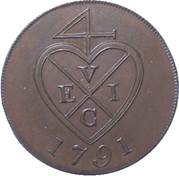
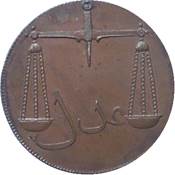
carrying this measure into effect, the Court have adopted the inscriptional
devices recommended by the Bombay Provisional Mint Master but have made a
material alteration in the proportions of the weight, as one of the [guiding]
principles that weighed with the Court in adopting the measure was to give
the public a coin not only surpassing the old in elegance of workmanship, but
also in intrinsic value, whereby they are better secured from impositions in
respect to its being counterfeited. With
the subsequent consignments, the Governor and Council will receive the
needful instructions respecting the points to be attended to in calling in
the old circulation & issuing the new, & until these shall be
received, the Court direct that the parcels now sent may on their landing be
housed and carefully secured ‘till the period of their issue. A
further 65 tons was duly received aboard the “Rockingham” with instructions
on how to issue them [4]. By the ship Essex of the
last season we forwarded you 34 tons 15 cwt? 2lb Of copper coinage, part of
the quantity of 100 tons intended for the use of Bombay and its subordinates
which we hope has come duly to hand. The ships Rockingham and Sulivan now under
dispatch will convey the remaining quantity. Agreeable
to the intimation conveyed in our secretary’s letter of the 3rd
May last we now proceed to communicate our instructions in respect to their
disposition: The coins were designed to be issued at a weight that
would deter counterfeiting: As counterfeiting the
circulating specie is an evil found to exist in most countries where the coin
passes at a rate far exceeding its intrinsic value (all charges of
workmanship included) we have for the purpose of checking a fraud of this
nature resolved that the large pieces weighing 200 grains each shall be
issued to exchange at the rate of 50 to a rupee. The second size weighing 150
grains, at 66⅔ to a rupee. The third size weighing 100 grains each, at
100 to a rupee. The smallest size weighing 50 grains, at 200 to a rupee. At
these rates of currency the public will receive for each rupee a quantity of
pure copper equal in weight to 10,000 avoirdupois grains. By the coin now in
circulation they receive only 7,314. The difference in this respect alone is
nearly 50 per cent in their favour which, combined with the elegance of their
appearance will we conceive not only secure them an early circulation in the
Company’s districts but be the means also of their finding their way into the
more interior parts of the country. Bombay was directed to issue a proclamation calling in
the old coins in exchange for the new: Upon the next of these
advices, we direct that you forthwith issue a proclamation at the Presidency
and the various subordinates signifying that all persons in possession of
copper pice of the Company’s former issues on or before the (naming such
period as shall allow reasonable time both for the Presidency and
subordinates) bring them in to the Company’s Treasury or such other place as
may be convenient for the purpose of receiving in lieu thereof an equivalent
in the coinage now sent. Notice must also be given that from and after such
date the old pice will be considered as no longer current. In the execution
of this order you must be attentive to being imposed upon in the receipt of
any other pice than those actually issued from the Company’s mint. We apprehend
if there are any counterfeits in circulation they may be easily distinguished
from the true ones. As the measures pursued by former Government on a similar
occasion (vide cons…) appear to be well calculated to secure our interests in
this respect we refer you thereto, and direct that they be adopted in the
present instance with any others that your experience and local knowledge may
suggest necessary on the occasion. The
total quantity shipped was 660 casks weighing 100 tons 14 cwts
2 qtrs 13½ lbs [5], broken down as follows:
From
these numbers, together with the known weight of each piece, the approximate number
of each denomination delivered to India can be calculated and compared to the
number known to have been produced [6]. These numbers match extremely
closely.
The
coins were to be issued at the rate of: 200s @ 50 to a rupee 150s @ 66 ⅔ to a rupee 100s @ 100 to a rupee 50s @ 200 to a rupee As
recorded above, the intention of this rate was to make one rupee worth 10,000
grains avoirdupois weight of copper (e.g. 200*50) compared to the then
existing rate of 7314 grains i.e. the coins contained less than their
intrinsic value of copper. This, combined with the greatly increased quality
of the design, would reduce the amount of forgery that was obviously worrying
the authorities at the time.
Pice
1791 Major
Pridmore makes a rather ambiguous comment about the fact that the Company had
established a mint at French Ordinary Court in London, and that this may have
played a part in the decision to manufacture the coins in England, rather
than locally in Bombay. This might imply that the coins were struck at a mint
in The coins were issued to the public by
a resolution dated 7th August 1792 [9]: The Board now proceed to
take into consideration the 7th, 8th, 9th,
10th, and 11th paragraphs of the Honble Company’s
commands of the 8th February last respecting the copper coinage
sent out by the ships of the season. Agreed that a publication be issued as
soon as possible signifying that all persons in possession of copper pice of
the Company’s former issues do, on or before the 30th September
next, bring them into the Company’s Treasury for the purpose of receiving in
lieu thereof an equivalent in the new coinage now sent out and for which the
public will receive for each rupee a quantity of pure copper equal in weight
to 10,000 avoirdupois grains, and by the coin now in circulation they only
receive 7314, the difference in this respect alone is nearly equal to 50 per
cent. As it is hereby declared that from and after the 1st
September next the old pice shall not pass current in this town or Island of
Bombay nor shall any person or persons be obliged to receive or accept the
same in payment and that any coin of a counterfeit kind shall immediately be
cut in two and forfeited to the Company for which purpose the necessary
minters and shroffs must attend at the Treasury, who shall be answerable for
the receipt of any pice not coined by the Company, and the Assistant to the
Treasurer must always be at the Treasury at the usual office hours that no
favour or affection may be shown to anyone. Agreed
also that the Assistant to the Treasurer be directed to issue the new coinage
after the 15th of the month in all payments to be made in pice. Resolved
also that copy of these paragraphs from the Company’s commands and our
proceedings thereon be sent to Tannah and Tellicherry and they be directed to
acquaint us what quantity of pice they have in circulation in order that we
may send a sufficient quantity of the new coinage to replace them. Pridmore
records that further deliveries occurred in 1792, 1793 and 1794. The
deliveries for 1792 delivery was probably the second load of 1791 coins and
perhaps more of these were delivered in 1793 although this has not been
confirmed. However, a second coinage was undertaken in 1793 and shipped to We approve the several
measures you have taken for issuing the copper coinage and have given the
needful directions for putting in hand the additional quantity you have
indented for. Attention will also be paid to your observation respecting the
different sizes and you will in all probability receive the whole quantity by
some of the later ships of the season. We
shall also communicate to the person employed in manufacture your remarks in
respect to the difference in outturn by weight and tale and desire that the
like if possible may be avoided in any future consignment.
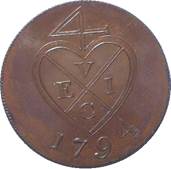
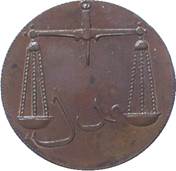
Pice
1794 The
1½ pice denomination was discontinued, presumably because it caused confusion
with the double pice. It would appear from the records that 50 tons of copper
coins were delivered this time [11]: The Accomptant General
lays before the Board a statement of the difference in produce between
delivering the copper coin by weight and by tale. This showed that approximately 50 tons of coins had been
delivered by three ships: The Raymond, the Woodford and Sir Edward Hughes |
||||||||||||||||||||||||||||||||||||||||||
|
Rarity 1791-1794 [12] |
The
rarest of the 1791/94 copper pice, apart from the pattern double pice, appears
to be the 1794 gilt proof half pice. One was sold in the Pridmore sale and
another exists in the |
|||||||||||||||||||||||||||||||||||||||||
|
Privy Marks 1791-1794 |
On
some coins, dots appear in the centre of the flan on either obverse or
reverse or both. These may have been privy marks deliberately added in the
mint but more likely they reflect the way in which the matrix dies were
produced (i.e. some kind of compass device use to mark out the circle). If
this assumption is correct then these dots are mistakes and should have been
removed before dies were produced. |
|||||||||||||||||||||||||||||||||||||||||
|
Varieties 1791-1794 |
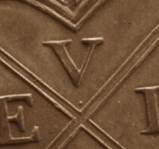
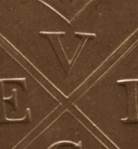
The
catalogue shows that some parts of the design vary more than others, e.g.
particularly the pivot on the reverse. This observation reveals something
about the way that the dies were produced. It seems likely that the majority
of the design was put onto some master punch and other features, such as the
pivot, were added later in the multiplication process |
|||||||||||||||||||||||||||||||||||||||||
|
|
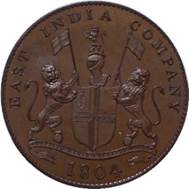
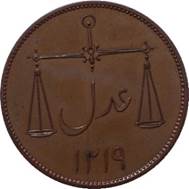
Double
pice, 1804 In
December 1802, the mint and assay masters wrote to the Bombay Government
suggesting that more copper coins should be sent from England and that a good
profit could be made from this [13]: …It is not only very
expensive to coin copper in this country but it is impossible with the
present machinery to do it well. It is harder than silver or gold & the
natives work it with less perfection. On this account it is certainly
desirable to have the copper money sent hither from England. Should
the present price of copper in England permit it, we would recommend that the
copper be sent of the same weight that they were in 1792, for any [change] in
the coinage should be avoided unless very necessary. If however it should not
be advantageous to the Honble Company of such a weight, we do not see any
material objection to reduce it to the rate that we proposed in our letter of
the 15th November. We refer to that letter regarding the copper
coins of 6 reas which weigh 150 grains. We are still of opinion that they are
unnecessary or inconvenient & that the other three pieces of 200, 100
& 50 grains each are quite sufficient for the purposes of this place. By
the accounts of copper coins in the Accountant General’s office, it appears
that the Honble Company in the years 1791, 2, 3 & 4 sent them from
England to the amount of rupees 70,592 . 2 . 57 by which there was a clear
profit of rupees 38,194 . 2 . 75. This is a considerable advantage & it
is one that will continue, for our copper coins are in demand not only in the
countries subject to the Company’s authority but in a certain degree also in
the Mahratta Territories. Whither they are gradually carried & never
return to us. It
would be very desirable to be able to determine the amount of copper coin
required for this side of India but after all our inquiries we are not as
convinced that it can be done with much accuracy. If this Government should
judge it proper to give them currency at Surat & its neighbourhood, which
has hitherto not been the case, a much greater number could be disposed of
than has yet been practicable. Mr
Galley, the Mint Master in 1788 stated that the amount of copper money in
circulation under this Presidency was about the following values: In
Bombay Rupees 100,000 Salsette
& [Carabjah] Rupees
25,000 Tellichery Rupees 10,000 Total Rupees 135,000 Since
that time the whole provinces of Malabar & Canara have come under the
Company’s authority & our money will be received in every part of them,
for altho’ they are placed at present under the Madras [Presidency] yet the
commercial connection & natural intercourse remain with Bombay. Upon
the whole we are of opinion that the Company may now send out from England a
quantity of copper coin equal to a lac of rupees, a certain proportion in
each ship. This may probably be disposed of without much delay, when an
estimate may be formed with more certainty then at present of the annual
quantity that is required for this Presidency. This
was passed to London with a recommendation that it be accepted: Ordered that the subject
of the above letter be brought to the notice of the Honble the Court of
Directors by the ships under dispatch with a recommendation that the quantity
of copper coin suggested in the concluding paragraph may be consigned to this
Presidency. |