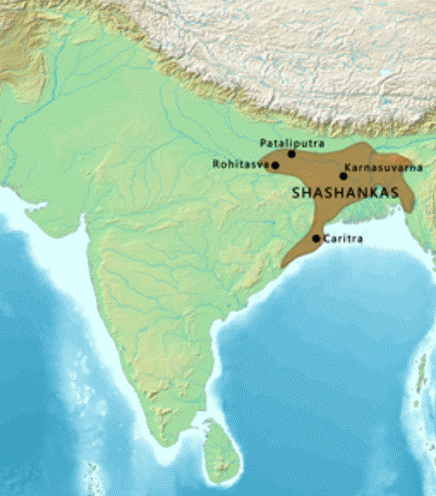
|
A Buddhist Mahāyāna Text Mañjuśrī-Mūlakalpa records
the existence of Gauda Kingdom in Bengal before it
was replaced by Gupta Empire in the 4th century. King Loka who was born in Vardhamāna
(Bardhamān) is mentioned who must have ruled
in the early 4th century CE. King Shashanka is
often attributed with creating the first separate political entity in a
unified Bengal called Gauda. He
reigned in 7th century, and some historians place his rule approximately
between 590 and 625. His capital was at Karnasubarna, 9.6
kilometres (6.0 mi) south-west of Baharampur,
headquarters of Murshidabad district. The Chinese monk, Xuanzang (Hiuen Tsang) travelled from the country of Karnasubarna to a region in the present-day state of
Orissa ruled by Shashanka. There is mention of Pundravardhana being
part of Gauda in certain ancient records. Not much
is known about the early life of Shashanka.
Historian D K Ganguly is reported to have concluded that he was a native of
Magadha.[7] The
same source reports that the historian Padmanath Bhattacharya took Shashanka to be a son of Mahāsenagupta.
R D Banerji concluded that he was descended from the Magadha Guptas. Nagendranath Basu has
argued that Shashanka was the son / descendant of
Raja Karnadeva, who founded the city of Karnasubarna in
Bengal. In some sources, Shashanka is described as a tribal leader of Bengal. Shashanka's name appears in multiple forms, including Śaśānka and Śaśānka-deva.
The name is derived from Sanskrit, as
another name for the Moon. Śaśānka-deva
therefore loosely translates to Moon god. The Hindu god Shiva is
also known as Shashank Sekhar as He holds the moon on his
head. The Chinese monk Xuanzang's writings,
he is mentioned as She-Shang-Kia. He is also called Śaśānka
Narendragupta, which initially lent credence to the
claim that he was descended from the later Guptas.[11] In
Sinha's Dynastic History of Magadha, the names 'Śaśānka'
and 'Soma' are used interchangeably. Some historians believe that Shashanka began his career as a feudatory chief (maha samanta) under Mahasenagupta, of the Later Gupta Dynasty.[12] And
that after the death of Mahasenagupta, Shashanka drove the later Guptas and other prominent
nobles out of the region and established his own kingdom with his capital at Karnasubarna. Other
historians like Sailendra Nath Sen is of the opinion that Mahasenagupta
- already under pressure from the Maukharis (for
failing to provide adequate protection) - wouldn't have knowingly appointed Shashanka to such an important position. Middleton (2015)
argues in a similar vein that Shashanka served
as maha samanta to
a Gauda king, possibly Jayanaga.[13] Whether
Shashanka was a feudatory under the Maukharis or the Guptas is not known. By 605 C.E.
following Mahasenagupta's death, Shashanka had established what became known as the Gauda Kingdom. From there, he issued gold coins to
celebrate his triumph, and came to be addressed as Maharajadhiraja (king
of great kings). According to some sources the city of Gauda was
founded by King Shankaladeva. He, originally, was a
native of Kannauj. In the
book, History of Hindostan (originally
translated from the book Gulshan-i-Ibrahimi written
by Firishta), it has been stated that Shankaladeva (Sinkol) was a
native of Kannauj (Kinoge)
and established the city of Gauda during the 8th
century BC. Following his death, Shashanka was
succeeded by his son, Manava, who ruled
the kingdom for eight months. However Gauda was soon divided amongst Harshavardhana and Bhaskarvarmana of Kamarupa, the
latter even managing to conquer Karnasuvarna. Evidence is inconsistent regarding links of Gauda with the Rarh region. While
Krishna Mishra (11th or 12th century), in his Prabodha-chandrodaya, mentions that Gauda
Rashtra includes Rarh (or Rarhpuri)
and Bhurishreshthika, identified with Bhurshut, in Hooghly and Howrah districts,
the Managoli inscription of the Yadava king Jaitugi I distinguishes
Lala (Rarh) from Gaula (Gauda). According to Jain writers of the thirteenth and fourteenth
centuries, Gauda included Lakshmanavati
in present-day Malda district. The Pala emperors were referred to as Vangapati (Lord of Vanga) and Gaudesvara
(Lord of Gauda). Sena kings
also called themselves Gaudesvara. From then Gauda and Vanga seem to be interchangeable names for the
whole of Bengal. (From
Wikipedia) |
c600 AD |