Bhandare S., (2012), JONS 210, p. 37)
Parendā
‘Parendā’
is presently known as ‘Parāndā’ (परांडा)
and located in the Osmanabad district of Maharashtra State. Its co-ordinates
are 18°15′N 75°25′E. It is a town dating back to the early medieval
period and a dynasty named as the ‘Sindas’ is known
to have ruled there as feudatory to the imperial houses of the Rashtrakutas and the Chalukyas of
Kalyani. Under their rule Parenda was known as Pratyandaka. Parendā rose to prominence under the
Bahmanis. Mahmud Gawan the prime minister of the
Bahmani Sultans constructed an impressive fortress at
Parendā in the 15th century AD (fig. 31). Curiously enough, it never saw
action in the half millennium of its existence! Locally, therefore, it is often
called the ‘Barren Fort’. Fig. 31 The fortress at Parendā In the first
decade of the 17th century, Murtaza II Nizam Shah (1600-1610) of Ahmadnagar
moved his court to Parenda, when he lost his capital
to the Mughals. After the eventual fall of the Nizamshahi
Sultans, the town and fort of Parendā was taken
over by the ‘Adil Shahi rulers of Bijapur and ultimately, towards the end of
17th century, by the Mughals. With the secession of the first Nizam, Asaf Jah I, the area around Parendā became part
of the Nizams’ domains. It remained a part of Hyderabad State until 1948. The
‘Imperial Gazetteer of India (Provincial Series) – Hyderabad State’ (Calcutta,
1909), mentions Parendā as the headquarters of a tālukā
(administrative division) of the same name, located in the Osmanabad district
of the Gulbarga Division of the Nizam’s Dominions. It was a ‘Crown’ or Sarf-i-Khās subdivision, with its entire revenue collection
contributing towards the Nizam’s personal wealth. The earliest numismatic
activity at Parendā took place while it was the temporary capital of
Murtaza II – he struck copper coins there with the mint-name Dār al-Mulk
Parendā (G&G N40-N43, p. 329). A Mughal mint began to produce silver
and gold coins there towards the end of Aurangzeb’s reign, in the early 18th
century, plausibly to supply money for the payment of troops engaged in battles
against the Marathas. Coins struck in the name of almost all successive rulers
till Muhammad Shah are
known but they are rare, or at best scarce, indicating the sporadic activity of
the mint. Copper coins are also known for some rulers like Shah
‘Alam I, Jahandar Shah and Farrukhsiyar. The coins of Parendā post-dating the
secession of Asaf Jah I in 1724 should be attributed to the Nizam.
Three such coins are published hereunder, all offered at ‘Todywalla Auctions’.
Two of them are in the name of Muhammad Shah – a silver rupee and a copper ‘Fulus’,
while one is in the name of ‘Alamgir II. In terms of
their fabric and calligraphy, they all bear vestiges of not being issues of an
imperial Mughal mint. The rupee in the name of Muhammad
Shah (fig. 32) was offered at Todywalla Auctions’
‘Budget Sale Auction no. 1’ (23 April 2010, Mumbai), lot 934. It is described
as under:
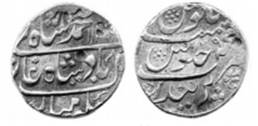
Fig.
32
Obv.:
Persian legend in three lines ّسکہ
مبارک باد شاه
غازی مح
ّمد شاه
sikkā mubārak bādshāh
ghāzī muḥammad shāh with the ‘k’ of the word
‘mubārak’ forming the second divider. The AH date is placed to the right
of the word ‘Muḥammad’, but is obliterated by a shroff mark, leaving only
‘11’ legible.
Rev.:
formulaic inscription with mint-name at the bottom – مانوس
ميمنت سنہ ٩ جلوس
ضرب پريندا
mānūs maimanat sanah 9 julūs ẓarb parendā
As
the RY here is 9, the coin must have been issued between 23- 11-1726 and
13-11-1727. The AH date may therefore be restored to 1139. The copper fulus or paisa (fig. 33) was offered at Todywalla’s
Auctions no. 56 (24 Sept 2011, Mumbai), lot no. 852. It weighs 13.6 g and is
described as follows:
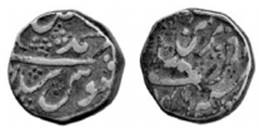
Fig.
33
Obv:
Persian legend in two lines فلوس
مبارک ّ محمد شا(ه)
fulūs mubārak muḥammad shā(h) The letter ‘k’ in the word ‘mubārak’ forms
the divider.
Rev:
Persian legend in two lines ضرب پريندا سنہ ٦ ۴)١١(
ẓarb parendā sanah (11)46
The
letter ‘b’ in the word ‘ẓarb’ forms the divider and there is a die-flaw
running diagonally across it. It is worth noting that, just above the
mint-name, there is a floral symbol – it is also found on the rupee described
above to the right of the mint-name on the reverse in its exactness. The symbol
might, therefore, have had a ‘mint-mark’-like
function. The date AH 1146 would mean the coin was struck between 3-6-1733 to
23-5-1734. It should be noted that a similar copper coin was published by Dilip
Balsekar and Sanjay Sahadev as of ‘Purandar’ mint and
attributed to the Marathas (‘Purandar: a New Maratha
Mint’, in ‘IIRNS-Newsline’, no. 45, January 2005). This was ostensibly because
the last alif in the mint-name is engraved slightly curved and therefore looks
like the letter ‘re’ or ‘R’. The mint-name had similarly confused early
numismatists like Charles Rodgers, S. Lane-Poole and R
B Whitehead – see discussion in PMC vol. II, p. lxii, where the mint-name is
read as ‘Purbandar’. Whitehead assigned a silver
rupee of Shah ‘Alam I (PMC no.
2034) to this mint, identified as the port city of Porbandar in Gujarat. A look at the illustration provided in plate XII
proves beyond doubt that it is a rupee of Parendā mint, not ‘Purbandar’. The coin in the name of ‘Alamgir
II is so far unique (fig. 34) and it was offered first
at Todywalla Auctions no. 49 (18 December 2010, Mumbai), lot 185 and again in
auction no. 56 (24 September 2011, Mumbai), lot 987. It may be described as
follows:
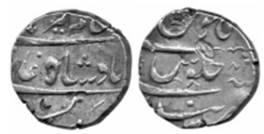
Fig.
34
Obv.:
Persian legend in three lines – س ّکہ
مبارک باد شاه
غازی عالم
گ ر ثانیي sikkā mubārak bādshāh ghāzī
‘ālamgīr thānī The letters ‘i’ in
the words ‘thānī’ and ‘ghāzī’, in their majhool,
or ‘extended’ forms, make the first and second dividers, respectively.
Rev.:
formulaic ‘julūs’ legend in three lines - مانوس
ميمنت سنہ ۴ جلوس
ضرب پريندا
mānūs maimanat sanah 4 julūs ẓarb parendā
The
mint-name is inscribed with the ‘end’ bit between ‘par’ and the final ‘ā’
elongated excessively. As a result the ‘Par’ part of
it is engraved below the elongated part and is, therefore, partly truncated.
The final ‘ā’ or alif is also not visible on the coin. In
spite of such incompleteness the mint-name can safely be restored to
‘Parendā’ owing to its orthography. RY4 of ‘Alamgir
II suggests this coin was struck between 1-5- 1