|
|
|
|
Marudhar
Arts who wrote: An
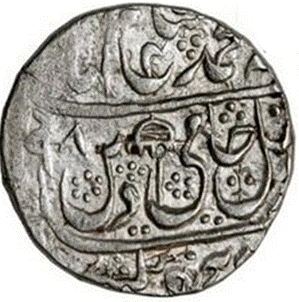
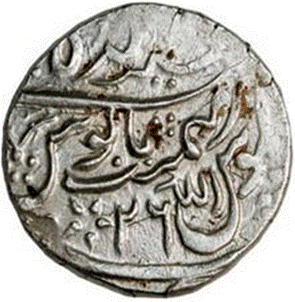
extra word 'Allah' is visible in the Persian 'Seen'. Mahadji
Sindhia was created Vakil-al-Mutlaq on 3 Dec. 1784, near Halena a place about
five miles north of Wer fort. The royal treasure and wealth was moved by
Afrasiyab Khan (the last Mir Bakhshi) to Aligarh, his personal Jagir.
Afrasiyab had placed the fort of Dig and the lands appertaining to it in
charge of Malik Muhammad Khan. His garrison on being paid their arrears by
Mahadji, evacuated the fort of Dig on 16 January 1785 and he occupied it by
his own troops under Devji Patil. Here Mahadji had to stop for two months
because of the fight for Agra, which surrendered on 27 March 1785. The next
step was to gain Aligarh fort. In order to be nearer to this place, Sindhia
marched up the river to Mathura (arrived 11 April 1785). At this holy city,
and later at Shergarh, about 25 Km north of Mathura, presently known as
Shergarh Bangar. Sindhia was camped at Shergarh from around 27 November 1785
to c. 10th January 1786, when he embarked on the Jaipur campaign. It shows
that the rupee concerned may have been struck at Shergarh, but not by
Sindhia. It must have been struck while the Afrasiyab's family was in
possession of Dig. Shergarh was a place where the Yamuna could be crossed. It
must have been the connecting road between Dig and Aligarh. That must also
been the reason for Sindhia that he moved to Shergarh for the capture of
Aligarh. Therefore the most likely candidate who was responsible for striking
this coin could be Malik Muhammad Khan, who was in charge of Dig fort, or by
Jahangir Khan who was in charge at Aligarh and perhaps more powerful than
Malik Muhammad in being Afrasiyab's brother. However the link with Dig is
more strong as the 'star'-like symbol to the left of the regnal year is a
mark frequently found on the rupees of Dig. |
|
|
|
|
|
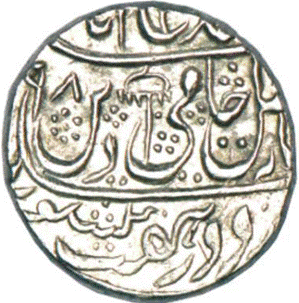
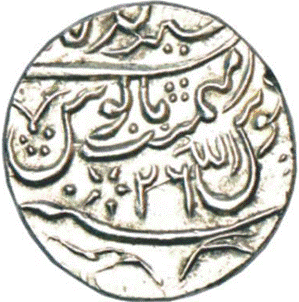
Photo
from Classical Numismatic Gallery who wrote: Footnote:
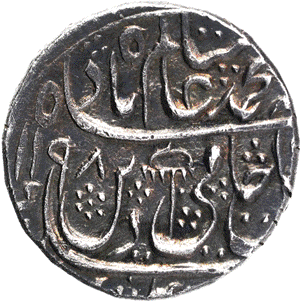
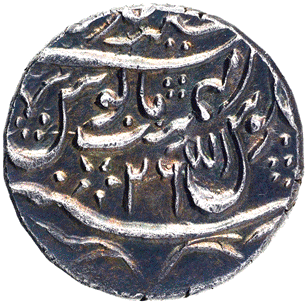
Coins from this mint are a recent discovery. They were most likely struck
during a tumultuous period of succession battles between various nobles of
the 'Mughalia' faction at the court of Shah Alam II, namely Afrasiyab Khan,
Abdul Ahad Khan, Zain al-Abidin Khan and Muhammad Beg Hamadani. The year on
the coin corresponds to late November 1783 to mid-October 1784. During this
period, there was intense rivalry brewing between Afrasiyab Khan and Muhammad
Beg. The latter had confiscated much of the area West and South of Agra,
including Braj. Afrasiyab sought the help of Mahadaji Sindhia to quell
Muhammad Beg's insubordination. Shergarh is located to the South-East of
Mathura and is an important crossing point on the Jamuna between Mathura and
Aligarh. During these struggles, it is known that Muhammad Beg once crossed
the Jamuna after encamping at Shergarh and went towards Jaipur. The coin
bears close resemblance with the rupees of the Jats struck at Deeg and it is
likely that Muhammad Beg Hamadani might have struck them during this short
stay at Shergarh. In all likelihood this must have been an emergency issue,
made to payments to the troops fighting on Muhammad Beg's side. |
|
|
|
|
|
Photo
from Kohinoor Auctions who wrote: Mahadji
Sindhia was created Vakil-al-Mutlaq on 3 Dec. 1784, near Halena a place about
five miles north of Wer fort. The royal treasure and wealth was moved by
Afrasiyab Khan (the last Mir Bakhshi) to Aligarh, his personal Jagir.
Afrasiyab had placed the fort of Dig and the lands appertaining to it in
charge of Malik Muhammad Khan. His garrison on being paid their arrears by
Mahadji, evacuated the fort of Dig on 16 January 1785 and he occupied it by
his own troops under Devji Patil. Here Mahadji had to stop for two months
because of the fight for Agra, which surrendered on 27 March 1785. The
next step was to gain Aligarh fort. In order to be nearer to this place,
Sindhia marched up the river to Mathura (arrived 11 April 1785). At this holy
city, and later at Shergarh, about 25 Km north of Mathura, presently known as
Shergarh Bangar. Sindhia was camped at Shergarh from around 27 November 1785
to c. 10th January 1786, when he embarked on the Jaipur campaign. It
shows that the rupee concerned may have been struck at Shergarh, but not by
Sindhia. It must have been struck while the Afrasiyab’s family was in
possession of Dig. Shergarh was a place where the Yamuna could be crossed. It
must have been the connecting road between Dig and Aligarh. That must also
been the reason for Sindhia that he moved to Shergarh for the capture of
Aligarh. Therefore the most likely candidate who was responsible for striking
this coin could be Malik Muhammad Khan, who was in charge of Dig fort, or by
Jahangir Khan who was in charge at Aligarh and perhaps more powerful than
Malik Muhammad in being Afrasiyab's brother. However
the link with Dig is more strong as the ‘star’-like symbol to the left of the
regnal year is a mark frequently found on the rupees of Dig. |
|