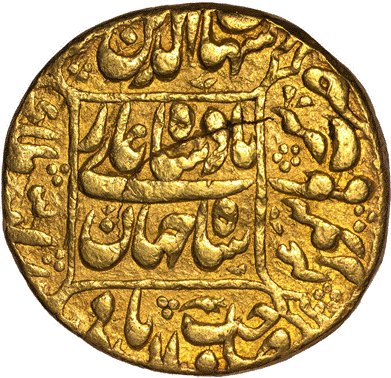
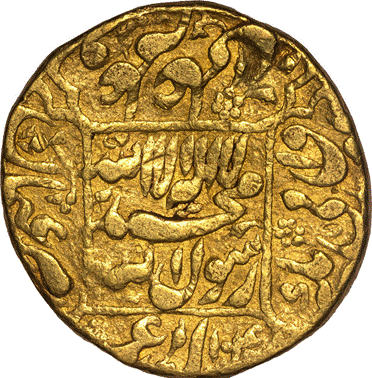
Mog-2275p. Wt = 11.37g. Diam = ~25.5mm

During the early reign of Shah Jahan, Burhanpur assumed strategic and dynastic importance. The city became a gateway to the Deccan and the stronghold of Shah Jahan during the Deccan campaigns. Moreover, in AH 1040 / Ry 4 (1631 AD) with the passing of Shah Jahan’s principal wife, Arjumand Banu Begum (Mumtaz Mahal) in Burhanpur made the city even more important as quick arrangements were made to bury her in the Zainabad Garden enclosure before her remains were transferred to Agra for the planned burial in the Taj Mahal.

During this year, Shah Jahan held formal darbars and court, issuing farmans, mansab and Jagirs. The offered mohur is evident of this precise period of flourishing economy in Burhanpur. The specimen struck on a large flan is almost Nazarana-like, showcasing its likely usage during the court proceedings at Burhanpur. Furthermore, the reverse of the coin bears the invocation Khallada Allāh Mulkahu (“May God perpetuate his kingdom”), a traditional epithet employed on Timurid coinage, which reflects the early dynastic and ideological foundations of the Mughal Empire. The presence of this epithet in the left quadrant of the reverse is particularly significant and represents a deliberate continuation of Timurid imperial symbolism.

(From Marudhar Arts)

Photo from Marudhar Arts, sale 53, lot 222