|
Rashtrakuta (rāṣṭrakūṭa) (r.
753-982 CE) was a royal Indian dynasty ruling
large parts of the Indian subcontinent between the sixth and 10th
centuries. The earliest known Rashtrakuta inscription
is a 7th-century copper plate grant detailing
their rule from manapur a city in Central or West
India. Other ruling Rashtrakuta clans from the same
period mentioned in inscriptions were the kings of Achalapur and the
rulers of Kannauj. Several controversies
exist regarding the origin of these early Rashtrakutas,
their native homeland and their language. The Elichpur clan was a feudatory of
the Badami Chalukyas, and
during the rule of Dantidurga, it
overthrew Chalukya Kirtivarman II and
went on to build an empire with the Gulbarga region
in modern Karnataka as its base. This clan came to be
known as the Rashtrakutas of Manyakheta, rising to power in South
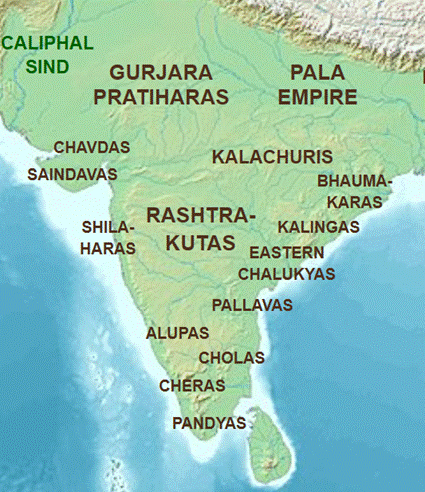
India in 753 AD. At the same time the Pala
dynasty of Bengal and the Prathihara
dynasty of Malwa were gaining force in eastern and northwestern
India respectively. An Arabic text, Silsilat
al-Tawarikh (851), called the Rashtrakutas one of the four principal empires of the
world.[3] This period, between the eighth and the 10th centuries, saw
a tripartite struggle for the resources of the
rich Gangetic plains, each of these three empires
annexing the seat of power at Kannauj for short
periods of time. At their peak the Rashtrakutas
of Manyakheta ruled a vast
empire stretching from the Ganges River and Yamuna
River doab in the north to Kanyakumari in
the south, a fruitful time of political expansion, architectural achievements and famous literary contributions. The early
kings of this dynasty were influenced by Hinduism and
the later kings by Jainism. During their rule, Jain mathematicians
and scholars contributed important works in Kannada and Sanskrit. Amoghavarsha I, the
most famous king of this dynasty wrote Kavirajamarga, a
landmark literary work in the Kannada language.
Architecture reached a milestone in the Dravidian style,
the finest example of which is seen in the Kailasanatha Temple at Ellora in
modern Maharashtra. Other important contributions are the Kashivishvanatha temple and the Jain Narayana temple
at Pattadakal in modern Karnataka, both
of which are UNESCO World Heritage Sites. |
c800 AD |